

Backlinks are an important part of making sure your website gets noticed on search engines like Google. Think of them as a vote of confidence from one website to another. The more high-quality backlinks you have, the more credible and valuable your site appears to Google, which helps it rank higher. Let’s understand the average costs of backlinks, changing trends, and underlying reasons as well as understand how BacklinkManager.io can help estimate costs and stop you from wasting dollars on spammy sites.
Average Cost of Backlinks- Summary
- Importance of Backlinks: Backlinks are like votes of confidence for your website, improving its SEO and ranking on Google. Quality matters more than quantity.
- Backlink Costs by Type:
- Niche Edits: $50 – $300 per link (inserted into existing content).
- Guest Posts: $80 – $150 for mid-level sites, higher for authority sites.
- Editorial Mentions: $900 – $1,500 for top-tier websites.
- Directory/Forum Links: Usually under $50 but considered low-quality.
- Backlink Tiers:
- Tier 1: High-quality links from authority sites; costs $100 – $1,000+.
- Tier 2: Supports Tier 1 links, costs $20 – $100.
- Tier 3: Low-quality links, generally $5 – $50.
- Factors Affecting Backlink Costs:
- Domain authority, relevance, niche competition, content quality, and traffic all impact pricing.
- High DA backlinks are costlier but provide more SEO benefits.
- BacklinkManager.io:
- Helps assess Domain Rating (DR) to estimate costs.
- Detects link farms and low-quality backlinks.
- Provides detailed backlink monitoring and ROI analysis.
- Quality Over Quantity: Fewer high-quality links from authoritative sites yield better results than many low-quality links.
- ROI Calculation: Consider potential traffic, conversion rates, and long-term benefits when determining if a backlink is worth the investment.

Estimate costs and avoid building wasteful links with BacklinkManager.io! CRM + Link Monitoring + Cost Analysis + Link Farm Detection

Why Are Backlinks So Important?
Backlinks aren’t just about connecting websites; they tell search engines, “Hey, this website has valuable content!” Search engines, like Google, use backlinks as a ranking factor. Google considers backlinks one of its top three factors when determining where your page shows up in search results.
Some compelling statistics that highlight the importance of backlinks:
👉 Backlinko discovered that the number of links pointing to a webpage is the most significant factor in Google rankings.
👉 Ahrefs reports that over 43% of top-ranking pages on Google contain reciprocal links.
👉 HubSpot found that businesses engaging in blogging receive 97% more backlinks than those that don’t.
👉 Aira reveals that 51% of marketers believe backlinks will remain a key ranking criterion in Google’s algorithms for the next five years.
👉 Ascend indicates that 13% of search experts view link building as the most valuable SEO tactic available today.
Consequentially, many companies are willing to invest heavily in backlinks to maintain visibility, increase traffic, and boost their business performance and you should too!
Link Quality Over Quantity

When it comes to backlinks, quality trumps quantity. A few high-quality backlinks can significantly enhance your SEO more than many low-quality ones. According to a study by Sparktoro, SEO professionals rank the quality of linked pages and sites as the second most important Google ranking factor.
Rather than chasing a high volume of links, it’s better to focus on securing endorsements from reputable and relevant sources. This approach not only strengthens your online presence but also helps you rise through the search engine rankings more effectively.
What is the Average Cost of Backlinks for My Site?
Backlinks are of several types and their costs vary depending on the source you built them from and the quality. Here’s a breakdown:
1. Niche Edits

Niche edits involve inserting links into existing, relevant content that is already indexed by search engines. These links are valuable because they leverage the existing authority and traffic of the host website.
- Average Cost Directly from Websites: $82 per link
- Average Cost from Link-Building Agencies: $73 per link
- Cost Range: $50 to $300 per link
- Pros: Quick to implement, often less expensive than guest posts, and can provide a natural link profile.
- Cons: The quality of the host content can vary, and there is a risk of the content being updated or removed.
2. Guest Posts
Guest posts are articles written for another website, which include a backlink to the author’s site. The cost varies significantly based on the domain authority of the host site. Here’s a table you can use to estimate the costs of guest posts.
| DR/DA/TF | Traffic | Fee |
| 10+ | 1,000 – 3999 | $30 – $60 |
| 20+ | 4,000 – 9,999 | $40 – $100 |
| 30+ | 10,000-99,999 | $80 – $150 |
| 40+ | 100,000 – 499,999 | $130 – $300 |
| 50+ | 500,000 | $800 – $15,000 |
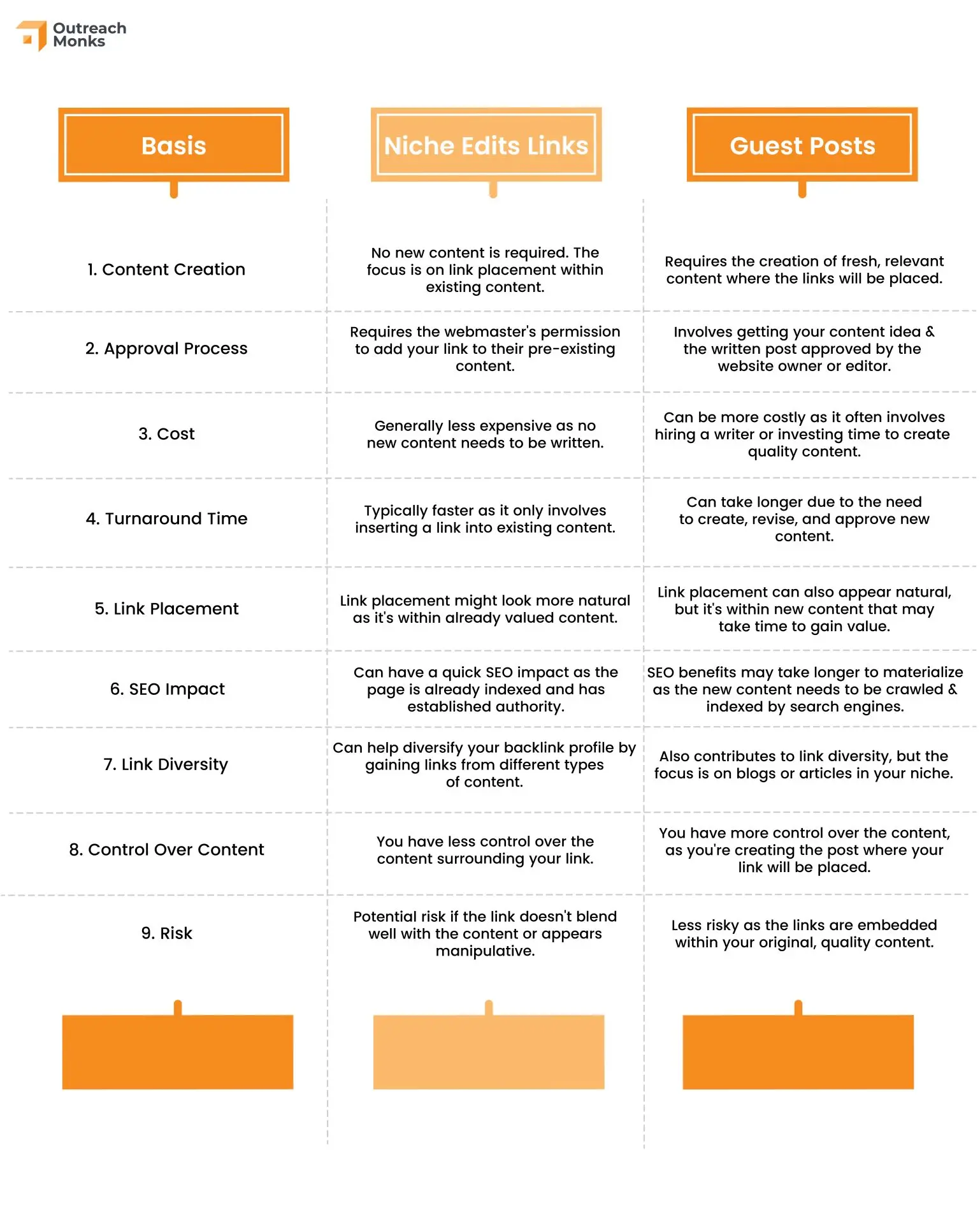
Guest Post vs. Niche Edits: Key Differences
Guest posts involve creating new content with a backlink, while niche edits insert a backlink into existing content. Guest posts require more effort, typically costing more than niche edits, which are quicker and less resource-intensive. Here’s an infographic showing more granular differences between the two.
3. Editorial Mentions
These are contextual links within high-quality content, often seen as the most valuable type of backlink. Securing these links usually requires strong relationships with content publishers.
- Average Cost: Typically ranges from $900 to $1500 for high-authority domains.
- Pros: Highly credible and can significantly boost your site’s authority and traffic.
- Cons: Difficult to acquire and often requires a strong PR strategy.
4. Directory or Profile Links
Directory or Profile links come from creating a listing or profile on a directory website. They are generally low quality and not recommended for SEO purposes.
- Average Cost: Generally low, often under $50 per link.
- Pros: Easy to obtain and can provide some level of visibility.
- Cons: Considered low quality and do not contribute significantly to SEO.
5. Forum Links

Subject matter experts can help people on discussion forums and side-by-side attach relevant links to their content but links obtained from forum discussions are also low quality and often do not contribute significantly to SEO.
- Average Cost: Usually negligible, often free.
- Pros: Can help in building community and brand awareness.
- Cons: Often viewed as spammy and can lead to penalties if overused.
| Type of Backlink | Average Cost | Cost Range | Pros | Cons |
|---|---|---|---|---|
| Niche Edits | $82 | $50 – $300 | Quick to implement, natural link profile | Varies in quality |
| Guest Posts | $91 (DR30) | $50 – $500 | Drives traffic, enhances reputation | Time-consuming |
| Editorial Mentions | $900 – $1500 | $900 – $1500 | Highly credible, boosts authority | Difficult to acquire |
| Directory Links | Under $50 | Under $50 | Easy to obtain | Low quality |
| Forum Links | Negligible | Free | Builds community | Can be spammy |
Backlink Costs by Tier
Backlinks can also be categorized into tiers based on their quality, authority, and the role they play in your overall SEO strategy.
Tier 1 Backlinks
These are high-quality backlinks from authoritative websites that directly link to your site. They are crucial for establishing domain authority and improving search engine rankings.
- Average Cost: Approximately $195, with prices ranging from $100 to $1000+ depending on the site’s authority and relevance.
- Examples: Links from major publications, industry-specific blogs, or high-traffic websites.
- Impact: Significant impact on SEO; these links are often the primary focus of link-building campaigns.
Tier 2 Backlinks
Tier 2 backlinks link to the pages that point to your site (i.e., your Tier 1 backlinks). They help to enhance the authority of your Tier 1 links and can improve their effectiveness.
- Average Cost:
- $47 when sourced directly from websites.
- $20 when obtained through agencies.
- Examples: Links from smaller blogs, relevant niche sites, or secondary content.
- Impact: Moderate impact; they support Tier 1 links and can help improve overall link equity.
Tier 3 Backlinks
These backlinks are of lower quality and often come from less authoritative sources. They typically support Tier 2 backlinks and can help to diversify your link profile.
- Average Cost: Generally ranges from $5 to $50.
- Examples: Links from low-quality blogs, comment sections, or social media profiles.
- Impact: Minimal impact on SEO; while they can contribute to a diverse link profile, they should not be the primary focus.
| Tier | Average Cost | Cost Range | Examples | Impact |
|---|---|---|---|---|
| Tier 1 | $195 | $100 – $1000+ | Major publications, authoritative blogs | Significant |
| Tier 2 | $47 | $20 – $100 | Smaller blogs, niche sites | Moderate |
| Tier 3 | $5 – $50 | $5 – $50 | Low-quality blogs, comments | Minimal |
Why Are Some Backlinks More Expensive Than Others?
The cost of backlinks varies depending on various factors. Here’s a breakdown of some of the most important factors that affect backlink costs:
1. Domain Authority
Domain Authority (DA), a metric from SEO tools like Moz, predicts a website’s ranking potential on SERPs, ranging from 1 to 100. Higher DA indicates a stronger ability to rank. Backlinks from high-authority sites are costlier due to their credibility. For instance, a backlink from a DA 90 site will cost more than one from a DA 20 site, because high DA sites pass more “link juice” that boosts your own site’s authority.
As demand for high DA backlinks grows, so do their prices. For example, backlinks from DA 50 sites may cost $350 to $450, while DA 60+ links can exceed $450.
2. Relevance of the Linking Site
Relevance denotes how closely related the linking site is to your content. Contextually relevant backlinks are more valuable because they are seen as endorsements by search engines. A health-related backlink from a reputable health blog is more beneficial than one from a general news site. Relevant links are often pricier due to their higher quality. A single high-quality, relevant backlink can be more advantageous than multiple links from unrelated sites, driving up their cost in competitive niches.
3. Niche Competition
The competitiveness of your niche influences backlink costs. Highly competitive niches, like finance or health, see higher backlink prices due to increased demand. In contrast, less competitive niches offer more affordable options. For example, high-quality backlinks in competitive areas might cost over $1,000, while those in less competitive fields may be as low as $100.
4. Quality of Content
The content quality where your backlink appears affects its cost. High-quality, well-researched content is more engaging and valuable, leading to higher backlink prices. A guest post on a high-traffic, well-written site may cost between $100 and $1,000, while backlinks from lower-quality content or directory listings might be cheaper.
5. Website Traffic
A site’s traffic volume impacts backlink costs. High-traffic sites offer greater visibility and potential referral traffic, making their backlinks more expensive. For example, a site with over 10,000 monthly visitors may charge more for a backlink than a site with fewer visitors. Some sites base backlink pricing on traffic levels, reflecting the additional value they provide.
6. Type of Backlink
The type of backlink also affects its price. More involved backlinks, like guest posts or niche edits, generally cost more than simpler ones. For instance, guest posts may range from $100 to $1,000, whereas directory submissions might cost $10 to $200. The effort and resources required for different types of backlinks justify their varying prices.
7. Agency vs. In-House Costs
The choice between hiring an agency for link building or managing it in-house can significantly influence backlink costs. Agencies often have established networks and processes that can lead to more efficient and effective link acquisition. However, their services can come at a premium, with costs ranging from $5,000 to $20,000 per link-building campaign.
On the other hand, building an in-house team may seem cost-effective, but it involves additional expenses such as salaries, training, and tools. In many cases, outsourcing to an agency can provide better results and save time, despite the higher upfront costs.
How to Calculate the ROI of a Backlink
To determine if a backlink is worth the investment, it’s essential to calculate the potential ROI.
Here’s a straightforward formula you can use:

- Potential Increase in Traffic: How much additional traffic can you expect from the backlink?
- Conversion Rate: What percentage of that traffic is likely to convert into customers?
- Average Value of a Customer: How much revenue does each customer generate on average?
Keep in mind that the ROI may not be immediate, as it can take time for the backlink to impact your search rankings and traffic.
How to Know if a Backlink is Worth the Cost?
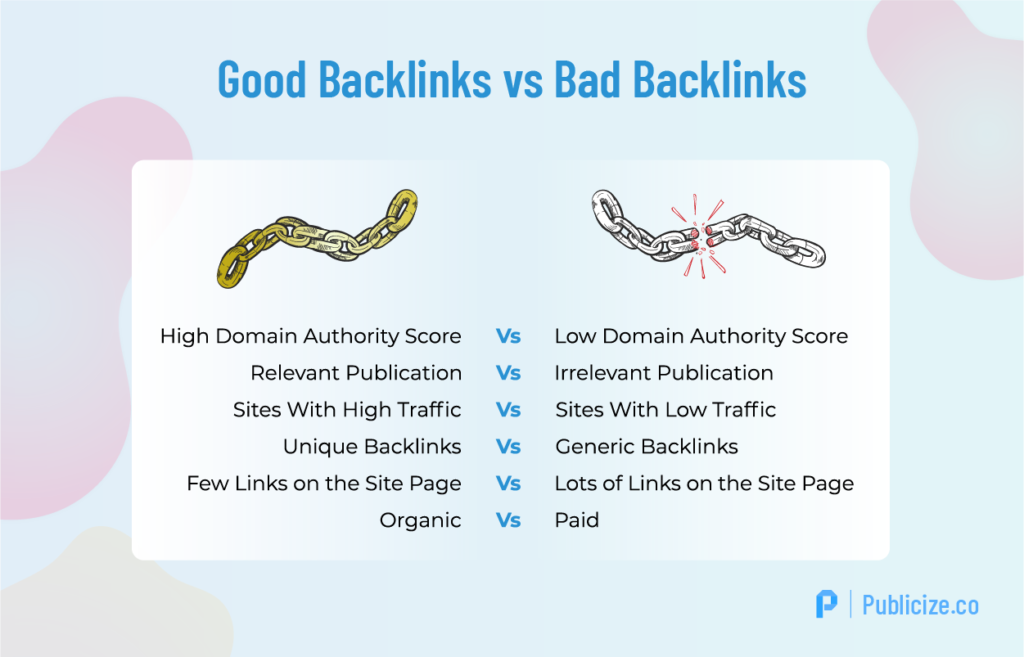
Before spending on backlinks, consider these factors:
- Authority and Relevance: Is the linking site high-authority and related to your niche? This increases the value.
- Potential Traffic: Will this link bring significant traffic to your site? Use tools like Ahrefs or Moz to check how much traffic the linking site gets.
- Long-Term Benefits: Good backlinks improve your site’s ranking over time, so think long-term. A backlink might not pay off immediately, but it could boost your site’s authority in the future.
- Risks: Be wary of shady tactics like buying low-quality links. These can harm your site by leading to penalties from Google.
BacklinkManager.io for Link Analysis and Cost Estimation
BacklinkManager.io is a game-changer when it comes to optimizing your link analysis and cost estimation processes. Let me break it down for you:
Evaluating Backlink Quality with DA and PA

The Domain Authority (DA) and Page Authority (PA) metrics are like your secret weapons for assessing the quality of potential backlink sources. Higher scores mean more authoritative sites, and you can use this info to set the right price for a backlink. This way, your investment aligns perfectly with the value it brings to your SEO strategy.
Identifying Low-Quality Links with Backlink Evaluator
BacklinkManager.io’s Backlink Evaluator is just what you need before you quote backlink prices. It gives you the info on indexability, Google indexation, the ability to be crawled, and outbound links. This helps you spot those pesky low-quality or spammy links and totally avoid link farms that could tank your SEO efforts. No more wasting money on ineffective backlinks!
Monitoring ROI and Link Performance

With 24/7 Automated Backlink Monitoring, you can keep tabs on your backlinks in real time. You’ll know if they’re do-follow, no-follow, or if they’re running into issues like 404 errors. This allows you to quickly fix any problems and make sure your ROI stays on track. Plus, the detailed reports give you a clear picture of your overall campaign performance.
Streamlining Reciprocal Link Building

BacklinkManager.io’s Partnership and Vendor Management features are perfect for building mutually beneficial relationships with other link builders. You can track targets, check the quality and status of links built, and chat directly within the platform. This streamlined process makes it a breeze to acquire high-quality backlinks at a lower cost.
Wrapping Up
Backlinks are crucial for boosting your website’s SEO, but their costs can vary depending on factors like site authority, relevance, and the type of backlink. For instance, niche edits generally range from $50-$300, while guest posts on mid-level sites might cost between $80-$150. High-end backlinks like editorial mentions can go as high as $1,500.
The secret to success lies in quality over quantity—a few high-quality backlinks from authoritative sites will benefit your SEO more than a bunch of low-quality links. To make this process easier, BacklinkManager.io offers a Backlink Evaluator tool that gives you metrics like Domain Rating (DR), which helps you estimate costs accurately. Plus, it helps you avoid link farms and low-quality links that could harm your SEO efforts.
With tools like this, you can track and manage your backlinks, ensuring you’re making the most of your investment and optimizing your link-building strategy for long-term success.
